
Computer Organisation and Architecture · Basic Computer Organization
Stored Program Architecture and General Purpose Computers
Overview
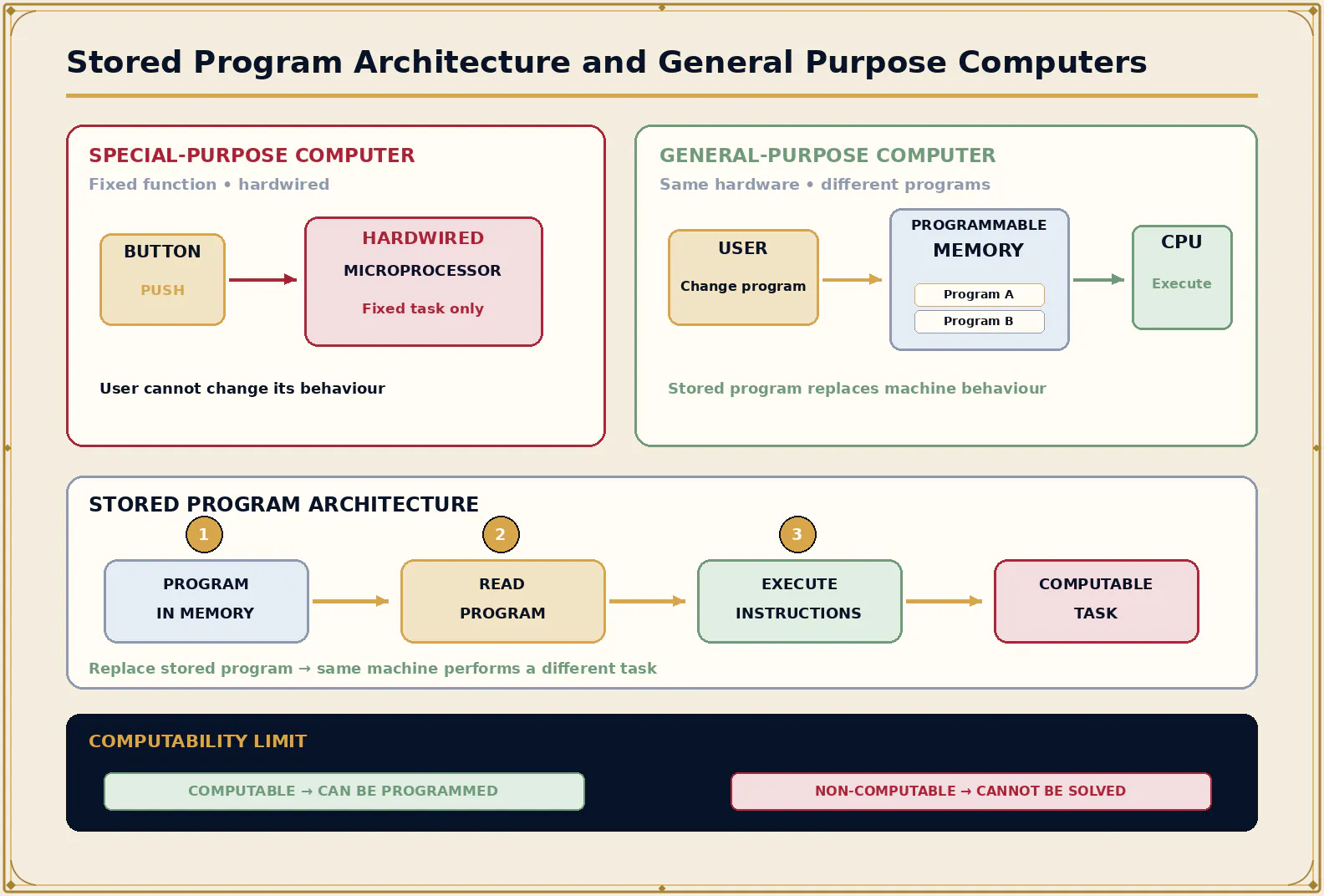
A general-purpose computer is defined by programmability: the user can change the program, and the same machine then performs different tasks.
The enabling element is programmable memory that holds the program itself, which is why this organization is called stored program architecture. The range of tasks such a machine can perform is bounded by computability.
Key concepts
- Dedicated (special-purpose) computer: contains a microprocessor that is already hardwired, so its function is fixed at design time. It is programmed to do only specific tasks, typically triggered by pushing a button.
- General-purpose computer: a machine that is programmable — the user can change the program, and by changing it the same machine can accomplish different things.
- Programmable memory: memory in which the program itself is stored. It is the key element that makes a machine general purpose; changing the stored program changes everything the machine does.
- Stored program architecture: the name for this organization, in which the program resides in programmable memory and the machine reads and executes whatever program is stored.
- Computability requirement: a general-purpose computer should be able to perform anything that is computable.
A non-computable problem cannot be solved by any computer; a computable problem should be possible to program on the machine.
How it works
- In a fixed-function machine, the microprocessor is hardwired and its behaviour cannot be altered by the user; it performs only the specific tasks it was built for, for example on pushing a button.
- Programmability is the differentiator: in a general-purpose computer the user can change the program, and the same hardware then performs a different task.
- The program is held in programmable memory. The machine reads and executes whatever program is stored, so replacing the stored program replaces the machine's behaviour — hence the name stored program architecture.
- The set of tasks the machine can perform is bounded by computability: only computable problems can be programmed, and any computable problem should be programmable.
- To build such a machine, the main elements required must be identified, starting from the set of instructions the machine must support.
Worked examples
No numerical examples are given in this section.
Comparison
| Aspect | Dedicated / special-purpose computer | General-purpose computer |
|---|---|---|
| Microprocessor | Already hardwired; function fixed at design time | Programmable; behaviour set by the stored program |
| Tasks performed | Only specific tasks, typically triggered by pushing a button | Anything computable that can be programmed |
| Who can change behaviour | Not the user | The user, by changing the program |
| Same machine, different tasks | Not possible | Possible by changing the program |
| Key enabling element | — | Programmable memory storing the program (stored program architecture) |
Revision summary
- The main difference between dedicated computers and a general-purpose computer is programmability — the user can change the program.
- Changing the program lets the same machine accomplish different things.
- The essential enabling element is programmable memory that stores the program; this is why the design is called stored program architecture.
- A general-purpose computer can do anything that is computable; non-computable problems cannot be done by any computer.
- If a problem is computable, it should be programmable on the machine.
- Building a general-purpose computer requires identifying the main elements/parts needed, starting from the required instruction set.
Previous-year exam insights
- The stored-program (von Neumann) architecture keeps both instructions and data in the same memory, uses a single memory for both, and executes instructions in the fetch-decode-execute cycle; this shared path is the source of the von Neumann bottleneck.
- The basic functional units of a general-purpose computer are the CPU (ALU + control unit + registers), main memory, and input/output units, interconnected by a system bus; the control unit fetches and decodes instructions and generates control signals, while the ALU performs arithmetic and logical operations.
- A special-purpose (dedicated/embedded) computer is designed for one fixed task and is not user-programmable, whereas a general-purpose computer can run any program loaded into its memory; the distinction is programmability, not hardware speed or size.
- The stored-program concept (von Neumann) allows the same hardware to perform different tasks by loading a different program, and it permits programs to be treated as data (self-modifying code, compilers, loaders).
- Computability is a theoretical limit: a problem is computable if an algorithm exists to solve it; no computer, however general purpose, can solve a non-computable (undecidable) problem such as the halting problem.
- In the fetch-decode-execute cycle the program counter holds the address of the next instruction, the instruction register holds the fetched instruction, and the memory address register/memory data register mediate memory accesses; an instruction consists of an opcode plus operand address(es).