
Computer Organisation and Architecture · Cache Basics
Cache Hit, Hit Latency, Cache Miss and Miss Latency
Overview
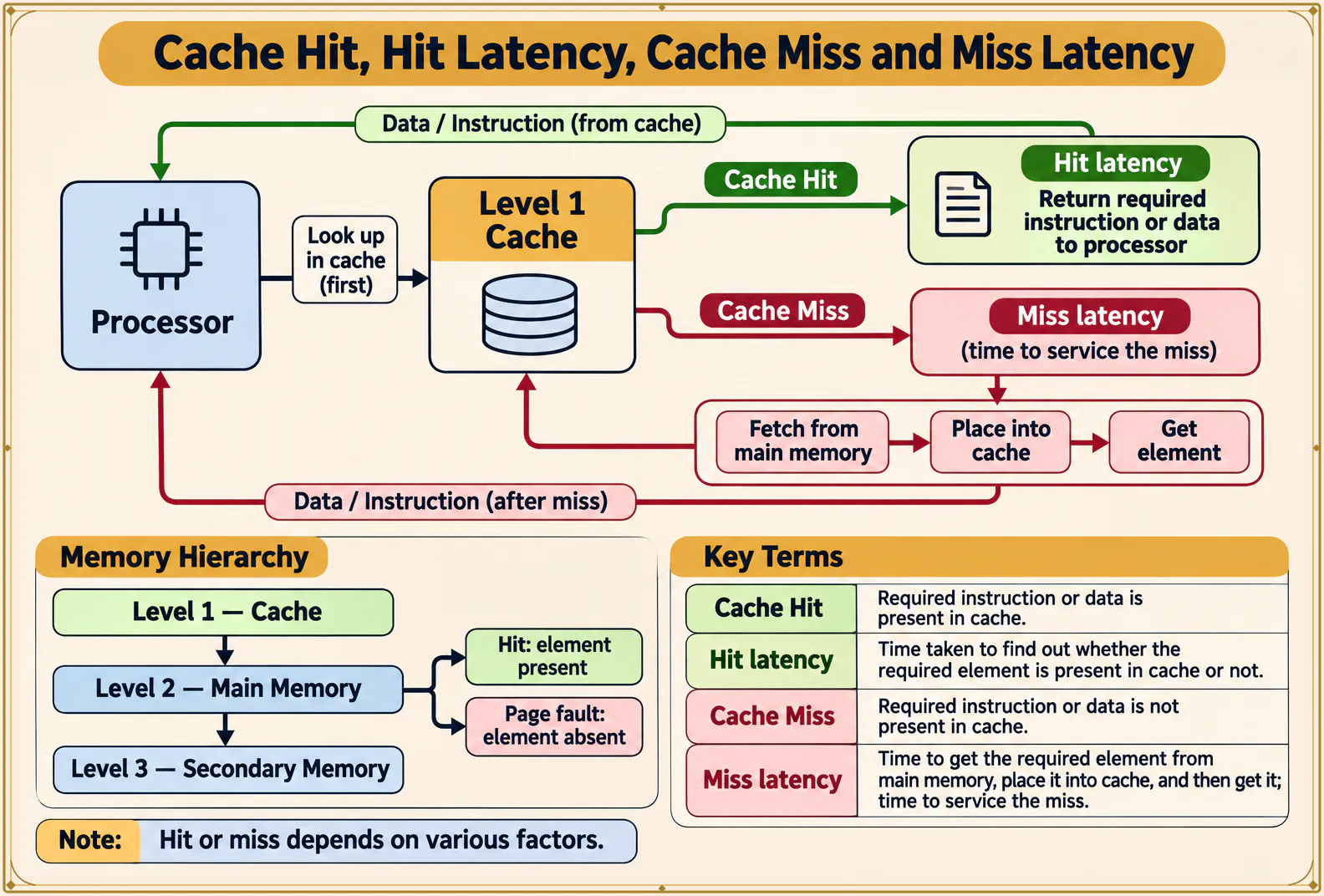
The memory hierarchy is considered with three levels: cache, main memory and secondary memory.
When the processor needs an instruction or data, it first checks the cache; whether the element is found there or not determines the hit or miss, and the time taken in each case is the hit latency or the miss latency.
Key concepts
- Memory hierarchy levels: Level 1 is the cache, Level 2 is the main memory (referred to in the context of paging), and Level 3 is the secondary memory.
- Cache hit: The required element (instruction or data) is found present in the cache when the processor looks into it.
- Hit latency: The time taken to find out whether the required element is present in the cache or not.
- Cache miss: The required element (instruction or data) is not present in the cache.
- Miss latency: The time taken to get the required element from the main memory, place it into the cache, and then get it — that is, the time taken to service the miss.
- Hit and page fault at the next level: The same hit/miss idea extends to the main-memory level.
If the required element is present in the main memory it is called a hit; if it is not present in the main memory it is called a page fault. - Whether a reference results in a hit or a miss depends on various factors.
How it works
- The processor first looks into the cache (Level 1) for the required element.
- If the required element is present in the cache, it is a cache hit. The time spent checking whether it is present or not is the hit latency.
- If the required element is not present in the cache, it is a cache miss.
- On a cache miss, the required element must be fetched from the main memory, brought into the cache, and then supplied; the total time for this is the miss latency.
- The same idea applies at the next level: an element present in main memory is a hit, and an element not present in main memory is a page fault.
Comparison
| Situation | Condition | Term | Time involved |
|---|---|---|---|
| Cache level | Required element present in cache | Cache hit | Hit latency: time to determine whether the element is present in the cache |
| Cache level | Required element not present in cache | Cache miss | Miss latency: time to fetch from main memory, place into cache, and then get it |
| Main-memory level | Required element present in main memory | Hit | — |
| Main-memory level | Required element not present in main memory | Page fault | — |
Revision summary
- Hit latency is only the time to check whether the element is in the cache — not the time to service a miss.
- Miss latency covers the whole miss service: fetch from main memory, place into cache, then get it.
- A miss at the cache level is not a page fault; a page fault is the "not present" case at the main-memory level.
- The hierarchy used is Cache → Main memory → Secondary memory.
- Hit/miss behaviour depends on various factors, so not every reference is a hit.
Previous-year exam insights
- Average memory access time (AMAT) = hit time + miss rate × miss penalty;
for multi-level caches, AMAT = L1 hit time + L1 miss rate × (L2 hit time + L2 miss rate × L2 miss penalty).
Asked inGATE 2022GATE 2020 - Miss penalty for a block fetch = block transfer time computed from the number of words in the block and the per-word transfer time (plus any latency to reach the first word);
the whole block is transferred, not just the requested word.
Asked inGATE 2020GATE 2019 - CPU time = ( + memory stall cycles per instruction) × instruction count × clock cycle time, where stall cycles per instruction = (instruction fetch misses per instruction × instruction miss penalty) + (data accesses per instruction × data miss rate × data miss penalty).
Asked inGATE 2024 - Speedup from a perfect cache = CPU time with real cache / CPU time with perfect cache = ( + stalls per instruction) / .
Asked inGATE 2024 - In a physically-indexed, physically-tagged cache with a TLB, a TLB miss requires a page-table walk before the physical address is known, so a cache hit cannot be reported before translation succeeds; a page-table miss (page fault) means the page is not in main memory, so a cache hit for that reference is impossible.
Asked inGATE 2026 - A cache miss and a page fault are different events at different levels: a cache miss is resolved from main memory, whereas a page fault requires fetching the page from secondary storage (disk), which is far slower.