
Computer Organisation and Architecture · Hardwired Control Unit
Role of the Control Unit and Timing Signals
Overview
The control unit is the hardware that generates the control signals for every processor activity and decides which unit drives the common bus and which unit reads from it.
Understanding its role and the timing signals it issues explains how the ALU, memory, and registers cooperate over a shared bus.
Key concepts
- Control Unit (CU): The part of the hardware responsible for (1) producing the control signals and (2) deciding which unit drives the common bus and which unit reads from it.
- Memory: The part of the hardware where instructions and data are stored.
- Registers: A form of memory used for temporary purposes.
- Flags: Simply flip-flops.
- ALU (Arithmetic Logic Unit): The part of the hardware that performs arithmetic and logic operations.
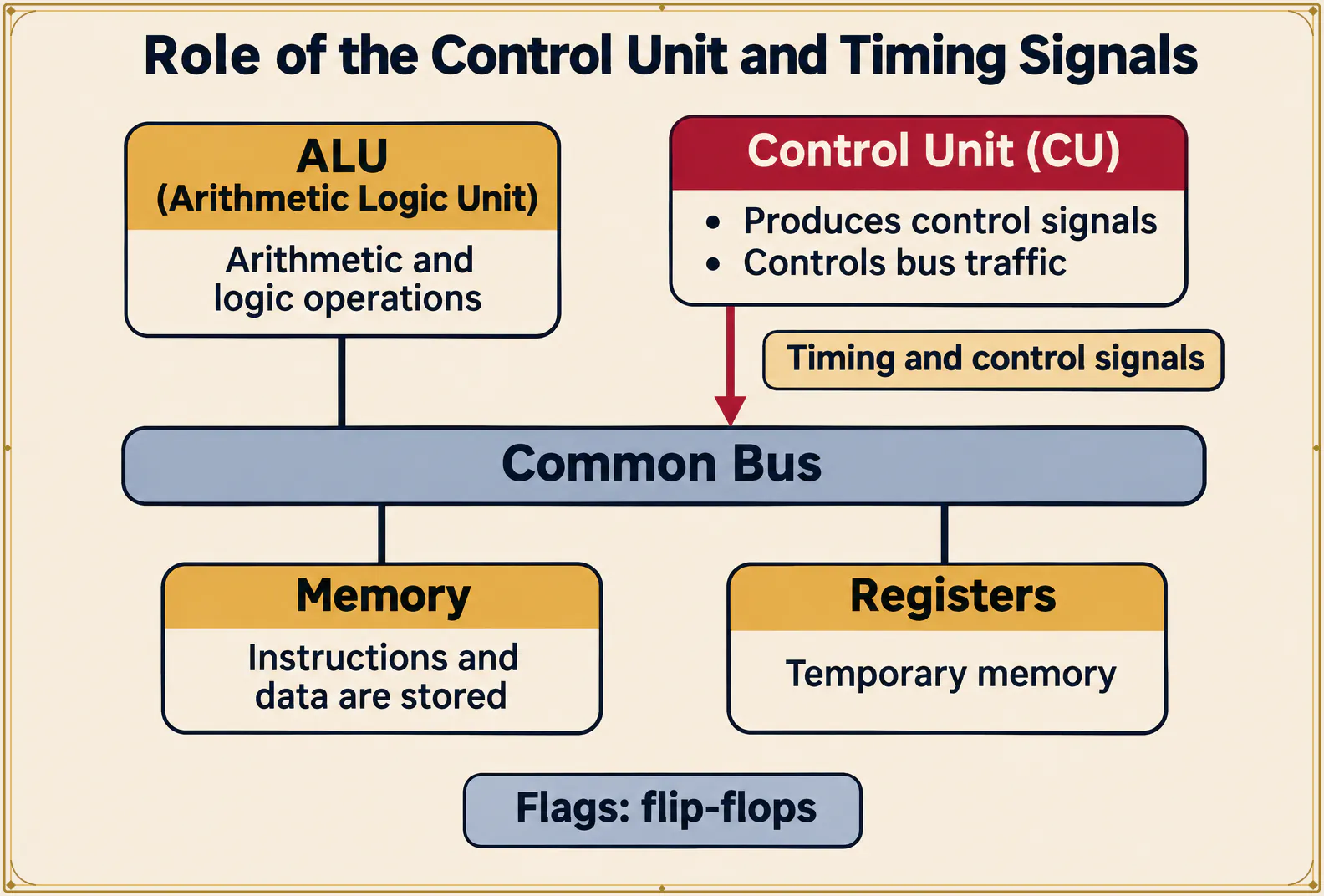
- Common bus: The single interconnection linking the ALU, the control unit, memory, and registers.
- Timing and control signals: The signals, generated by the control unit, that govern transfers on the bus — what is pushed onto the bus and who reads it.
How it works
- All activities of the processor require someone to produce the control signals; producing these signals and controlling bus traffic are the two jobs mainly taken care of by hardware.
- The part of the hardware responsible for these two things is the control unit.
- Instructions and data are stored in memory; for temporary purposes registers are used, which are also a form of memory.
- Flags are nothing but flip-flops.
- The ALU performs arithmetic and logic operations: comparators (as seen in digital logic), adders, and a subtractor implemented from the adder; similarly a multiplier and a divisor can be built using the adder.
All hardware doing such activities is present in the circuit called the ALU. - The overall organization has one unit called the ALU, another called the control unit, memory, and registers, all connected by a common bus.
- The control unit decides what has to be pushed onto the bus and who has to read it from the bus, using the timing and control signals.
- How the parts are built:
- Flags → flip-flops.
- Memory → as studied.
- ALU → designed using logic gates: adder, comparator, subtractor (and multiplier/divisor from the adder).
- Registers → a sequence of flip-flops.
- Timing signals → generated by the control unit, implemented using a sequence counter.
Revision summary
- The control unit has exactly two responsibilities: generating control signals and controlling the common bus (who writes, who reads).
- Memory stores instructions and data; registers are temporary memory; flags are flip-flops; the ALU does arithmetic and logic operations.
- All units — ALU, control unit, memory, registers — are interconnected by a common bus.
- Bus transfers are governed by timing and control signals issued by the control unit.
- Building blocks: ALU from logic gates (adder, comparator, subtractor, multiplier, divisor); registers from sequences of flip-flops; flags from flip-flops.
- Timing signals are generated by the control unit, implemented using a sequence counter.
Previous-year exam insights
- Hardwired control is the fastest control-unit implementation; among microprogrammed units, horizontal microprogramming is faster than vertical microprogramming (vertical needs decoding of a compact field, horizontal has one bit per control signal and needs no decoders but gives wider microinstructions).
Asked inGATE 1999GATE 2002GATE 1987UGC NET 2020 - A microprogrammed control unit stores microinstructions in a control memory; it is slower than hardwired control but allows easy modification/addition of instructions, whereas hardwired control is fast but costly to change.
Asked inGATE 1987ISRO 2018UGC NET 2020 - In horizontal microprogramming each control signal has its own bit (no signal decoders needed), so microinstructions are wider than in vertical microprogramming, where an encoded field of n bits can select one of signals and requires a decoder.
Asked inGATE 2002GATE 1996 - Minimum control-word bits for N control signals of which at most one is active at a time (mutually exclusive): use one encoded field of ceil() bits (the +1 accounts for the 'none active' case); if several signals can be active simultaneously, use one bit per signal (or group the signals into mutually exclusive fields, each encoded separately).
Asked inGATE 1996GATE 1997 - Control memory size = words;
the MUX-select field width is ceil() since it selects one of the status inputs.
Asked inISRO 2009 - A control signal for a register transfer is the OR of the instruction-time terms that activate it, i.e. each control signal is a Boolean function of the instruction opcode and the timing step (e.g. of the form ·), which is how hardwired control is designed.
Asked inGATE 2004
Processor units on common bus
Drawing the diagram…
Shows the ALU, control unit, memory and registers all linked by the common bus, with the control unit issuing timing and control signals.