
Digital Logic · Boolean Algebra and Logic Gates
Basic Properties and Identities of Switching Algebra
Overview
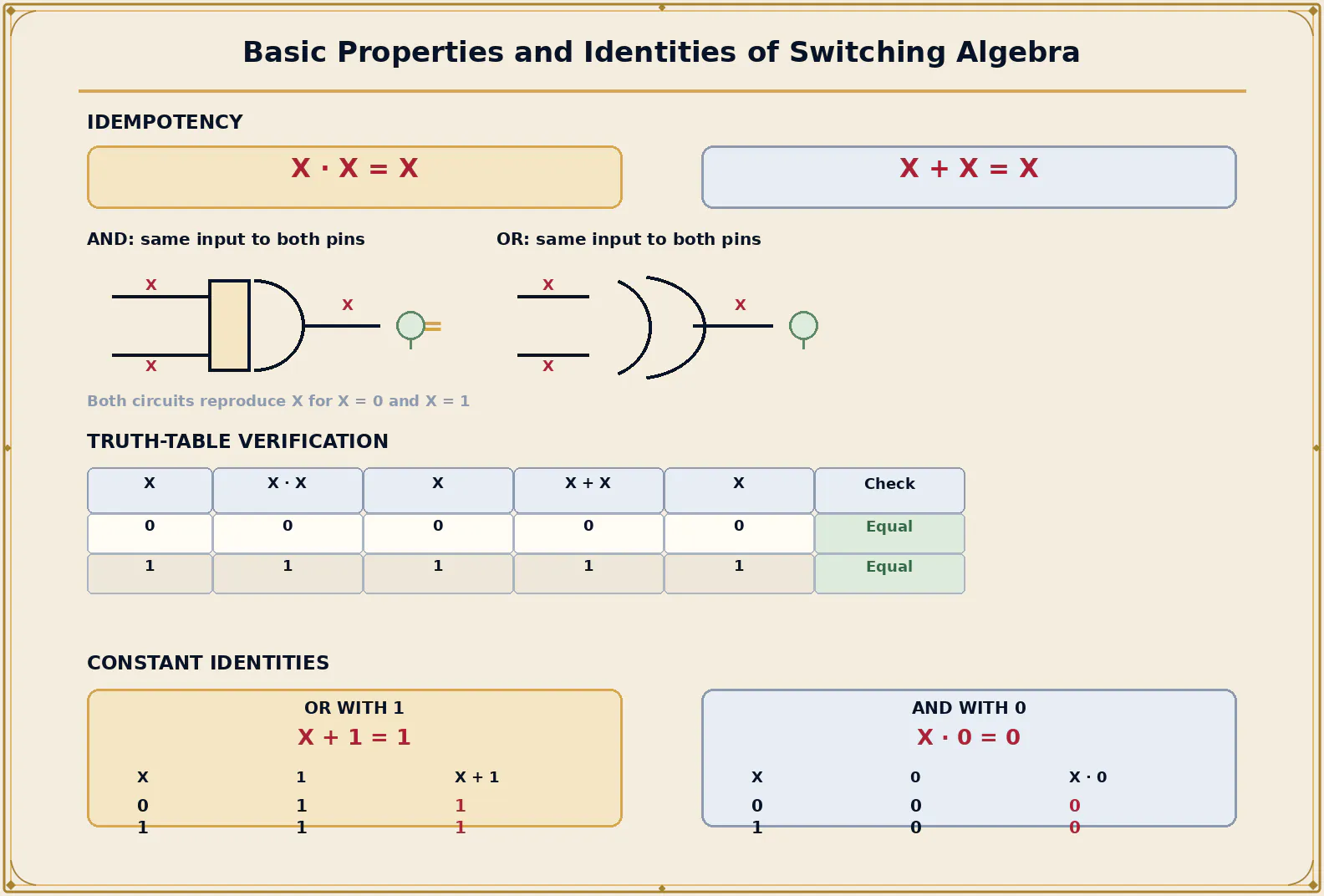
Switching algebra (Boolean algebra) obeys a small set of basic identities that let logic expressions be simplified and proved. The identities covered here are idempotency, dominance with 1 under OR, and dominance with 0 under AND, each verified by truth table.
Key concepts
- Idempotency: An operation applied to a variable with itself returns the same variable. It holds for both OR and AND: and .
- Verification principle: A Boolean equation is valid only if LHS = RHS for every input combination. To check it, build the truth table and compare the LHS and RHS columns row by row.
- OR with 1: Anything ORed with 1 gives 1, whatever the other value is.
- AND with 0: Anything ANDed with 0 gives 0, whatever the other value is.
- AND behaviour: AND produces 1 only when both operands are 1; otherwise it produces 0.
How it works
- Write the expression for the LHS and the expression for the RHS.
- Construct the truth table covering all input combinations.
- Evaluate the truth value of the LHS and of the RHS for each combination.
- If LHS = RHS for every row, the equation is correct.
Formulas
-
— idempotent law for OR
-
— idempotent law for AND
-
— OR identity (dominance with 1)
-
— AND identity (dominance with 0)
-
Here is a Boolean variable taking the value 0 or 1; is OR and is AND.
Worked examples
Example 1: Verify
| 0 | 0 | 0 |
| 1 | 1 | 1 |
LHS = RHS in every row, so is verified.
Example 2: Verify
| 0 | 0 | 0 |
| 1 | 1 | 1 |
LHS = RHS in every row, so is verified.
Example 3:
| 0 | 1 |
| 1 | 1 |
The result is 1 irrespective of .
Example 4:
| 0 | 0 |
| 1 | 0 |
The result is 0 irrespective of .
Revision summary
- Idempotency: and .
- ORing with 1 always gives 1; ANDing with 0 always gives 0, regardless of the other operand.
- AND gives 1 only when both operands are 1; otherwise it gives 0.
- An equation is valid only if LHS = RHS for all input combinations — a match in some rows is not enough.
- Shortcut: When you see a 1 in an OR operation, the result is 1; when you see a 0 in an AND operation, the result is 0.
Previous-year exam insights
- Complement laws: X + X′ = 1 and X · X′ = 0;
also (X′)′ = X. Note that X · X′ = 1 is NOT a valid identity.
Asked inGATE 2026GATE 2024 - Identity (neutral) elements: X + 0 = X and X · 1 = X — these are distinct from the dominance laws X + 1 = 1 and X · 0 = 0.
Asked inGATE 2024 - Commutative law: X + Y = Y + X and X · Y = Y · X;
associative law: (X+Y)+Z = X+(Y+Z) and (X·Y)·Z = X·(Y·Z).
Asked inGATE 2026GATE 2019 - XOR properties: XOR is commutative and associative, X ⊕ X = 0, X ⊕ 0 = X, X ⊕ 1 = X′, and X ⊕ Y ⊕ X = Y (a variable XORed with itself an even number of times cancels).
Asked inGATE 2019GATE 1987 - Absorption laws: X + X·Y = X and X·(X+Y) = X;
also X + X′Y = X + Y and X·(X′+Y) = X·Y.
Asked inUGC NET 2008 - For Boolean functions F and G, F ≤ F + G and F·G ≤ F (since F·G ≤ F ≤ F+G); a Boolean function's value is 0 or 1, so ordering is the pointwise implication order.
Asked inUGC NET 2013