
Digital Logic · Latches and Flip-Flops
Introduction to Sequential Circuits and Feedback
Overview
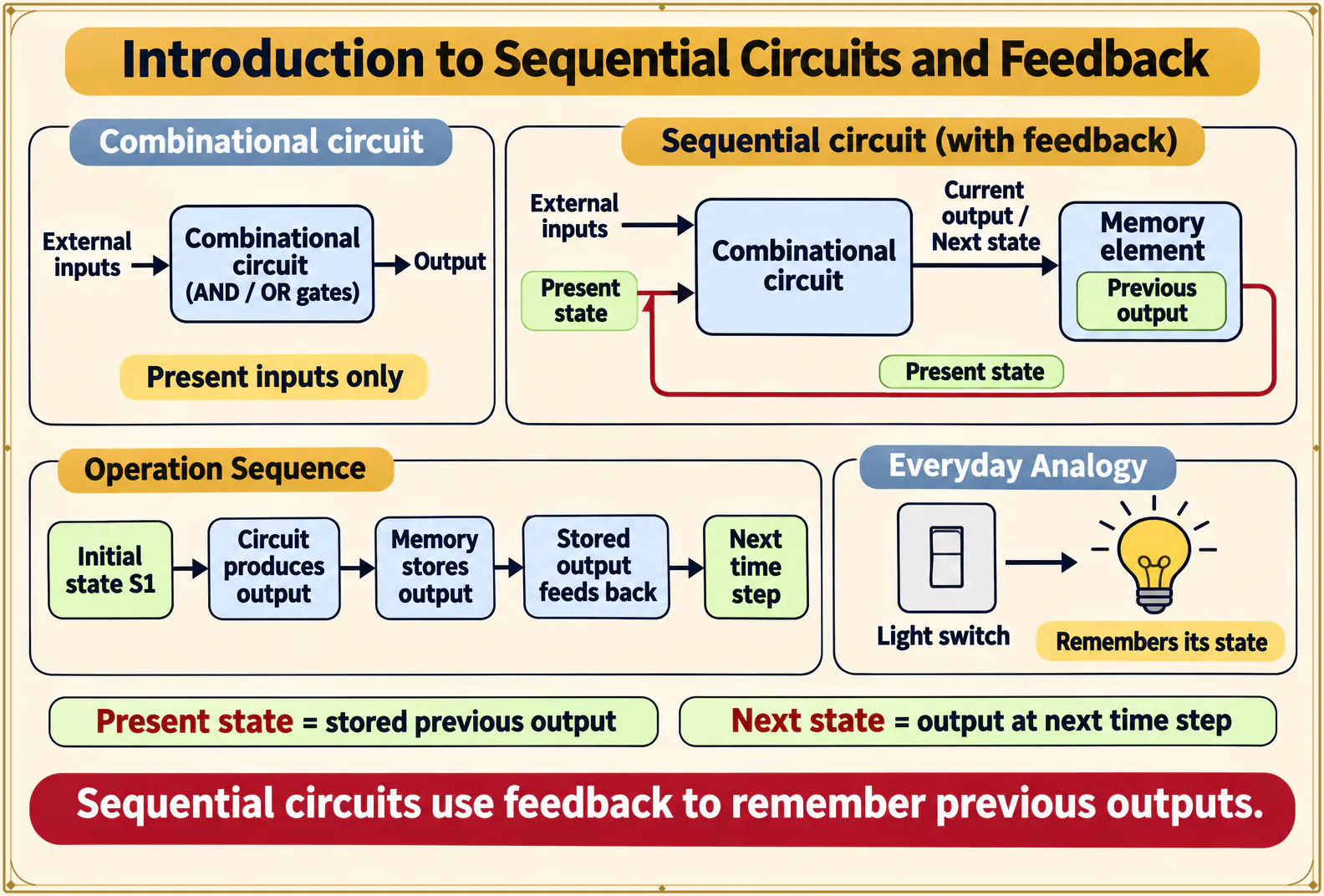
A combinational circuit's output depends only on its present inputs, while a sequential circuit's output also depends on its past — the previous outputs it has produced.
The key addition that makes this possible is a memory element, which stores the previous output and feeds it back as an input, giving the circuit a present state and a next state.
Key concepts
- Combinational circuit: A circuit built from gates (AND, OR, NAND, etc.) in which the output is only a function of the present inputs. There is no feedback — nothing is taken back from the output to the input.
Examples: decoder, encoder, multiplexer, and any function realized with AND/OR gates. - Sequential circuit: A circuit in which the output depends not only on the present inputs but also on the previous history — that is, on the outputs produced so far.
The new output depends on the entire history of the circuit. - Memory element: A storage element that holds the output produced in the previous state (or the output produced till now) and feeds it back to the combinational circuit.
- Present state / Next state: The contents held in the memory element (the previous outputs fed back) are the present state; the output produced in the next time step is the next state.
How it works
- Start with an ordinary combinational circuit (the block containing AND/OR gates, decoder, encoder, multiplexer, etc.). It takes only external inputs and produces outputs — nothing is fed back.
- Add a memory element to this combinational circuit. The output produced in the previous state (the output produced till now) is stored in this memory element.
- The memory element gives this stored value back as an input to the combinational circuit. The combinational circuit now has two kinds of inputs:
- the external inputs, and
- the outputs produced in the previous state (the present state).
- Using both, the circuit produces the current output. Hence the output is not just a function of the input — it also depends on what happened earlier.
- The dependence is not on just one previous state but on the entire history: starting from the initial state S1, the circuit produces an output; that output is passed to the next state; the next state produces another output, which is passed on again, and so on.
Therefore at any state the circuit is effectively carrying the influence of the whole history, not merely the immediately previous output.
Comparison
| Feature | Combinational circuit | Sequential circuit |
|---|---|---|
| Output depends on | Present inputs only | Present inputs + present contents of memory element (previous outputs / history) |
| Feedback | Absent | Present (memory element feeds output back to input) |
| Memory element | Not present | Present — this is the key difference |
| Examples | Decoder, encoder, multiplexer, AND/OR gate realizations | Circuits built with memory elements (latches/flip-flops) |
Revision summary
- The single defining difference between combinational and sequential circuits is the presence of the memory element (feedback).
- In a sequential circuit, the external output depends on the external inputs and on the present contents of the memory element.
- The contents of the memory element are called the present state; the state reached at the next time step is the next state.
- Because each state's output is passed on to the next state, the output at any time reflects the entire history of the circuit, not just the last output.
- Combinational circuits seen so far (decoder, encoder, multiplexer, gate-level realizations) involve no feedback at all.
Previous-year exam insights
- A sequential circuit is described by: next state = f(present state, present inputs) and output = g(present state, present inputs) for a Mealy machine, or g(present state) only for a Moore machine;
the memory element holds the state.
Asked inUGC NET 2014UGC NET 2016 - Latches are level-sensitive (transparent while the enable is active) and have no clock edge; flip-flops are edge-triggered (change state only at a clock edge).
Both are bistable memory elements and are the basic building blocks of sequential circuits.
Asked inUGC NET 2018 - A circuit with feedback built from gates can be analysed by writing the next-state/output equations and constructing a state (transition) table; a state is stable when the next-state value equals the present-state value for the given inputs.
Asked inGATE 1993GATE 2005 - In an asynchronous (unclocked) feedback circuit, when the input changes the output may oscillate or settle to a stable state;
the condition for a stable state is obtained by solving next-state = present-state for the given input combination.
Asked inGATE 1993 - With gate propagation delays, a combinational circuit with feedback can produce transient pulses (hazards/glitches) before settling; with zero delay the same circuit's output is determined purely by the steady-state logic equation.
Asked inGATE 2024 - Classification trap: multiplexers, decoders, encoders, adders and other gate-only circuits are combinational; counters, registers, latches and flip-flops are sequential because they contain memory/feedback.
Asked inUGC NET 2016UGC NET 2018