
Digital Logic · Multiplexers and Demultiplexers
Block Diagram and Select Lines of a 4:1 Multiplexer
Overview
A multiplexer (MUX) selects one of several input lines and connects it to a single output line. A 4:1 multiplexer has four inputs and one output, with select lines deciding which input reaches the output.
Understanding the block diagram and select lines is the basis for analyzing and designing any multiplexer.
Key concepts
- Multiplexer (MUX): selects one of several input lines and connects it to a single output line.
- 4:1 multiplexer: has 4 inputs and 1 output; any one input is chosen and shown at the output, which is why it is called 4 by 1.
- Input naming: inputs are named I0, I1, I2, I3, numbered consistently from 0.
- Select lines: control which input is selected; the number of select lines depends on how many inputs must be distinguished.
- Characteristic table: the table relating select lines to output, showing what the output is in terms of the inputs.
How it works
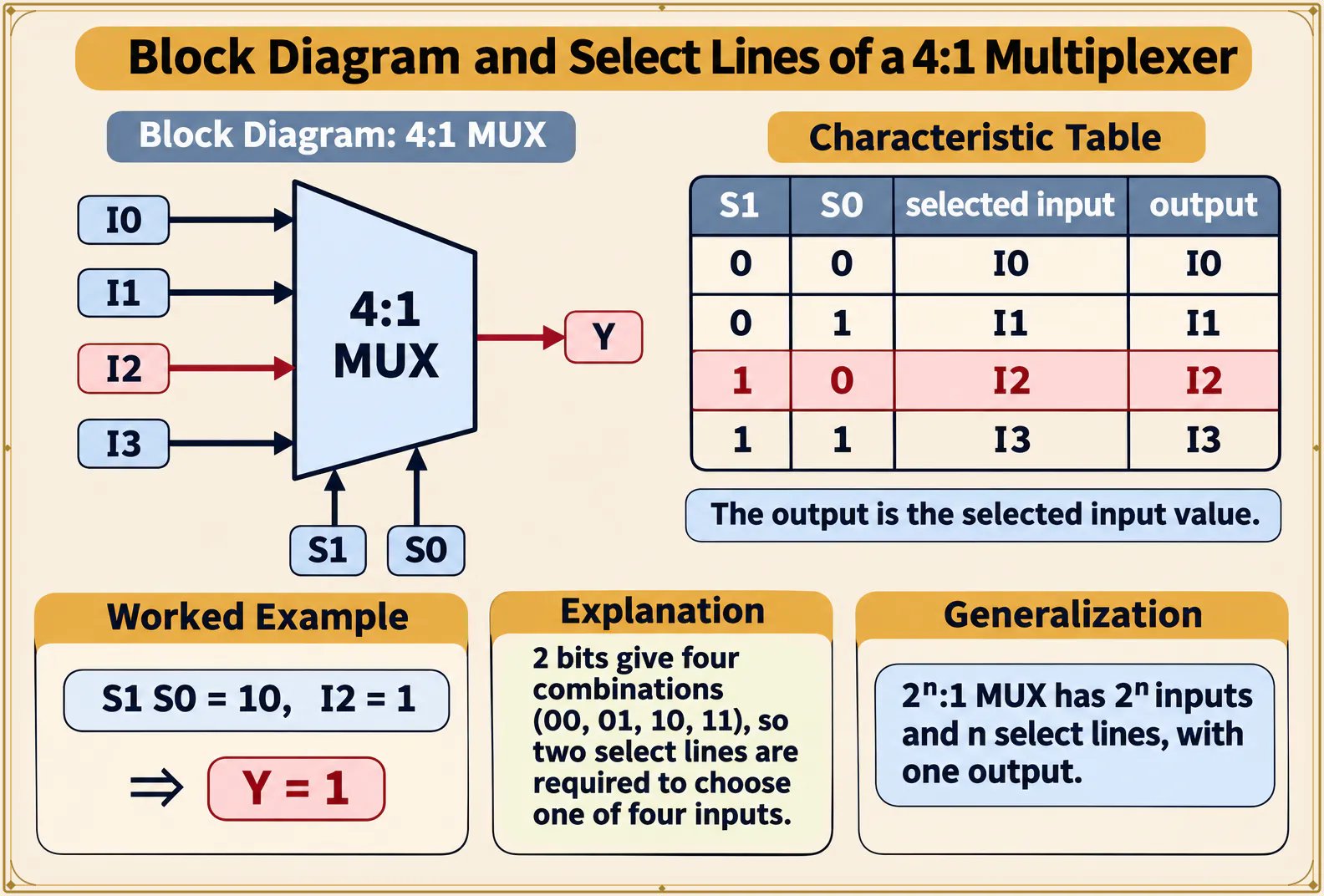
- The block diagram of a 4:1 MUX has four inputs I0, I1, I2, I3, one output, and select lines that decide which input reaches the output.
- To choose 1 out of 4 inputs, count how many bits are needed to represent four possibilities: 2 bits give the combinations 00, 01, 10, 11 — exactly four combinations.
- Each combination is assigned to one input, so 2 select lines (S1, S0) are needed.
- The two select lines decide which input is connected to the output:
- If select lines = 00, whatever is on I0 appears at the output.
- If select lines = 01, output = I1.
- If select lines = 10, output = I2.
- If select lines = 11, output = I3.
- Generalization to a multiplexer: there are input lines, one of them is selected and given to the output; the number of bits required to choose one of combinations is bits, so in a MUX, is the number of select lines.
Formulas
-
— number of select lines for a MUX, where = number of inputs ().
-
For a 4:1 MUX: , select lines.
-
4:1 Multiplexer Block Diagram
Drawing the diagram…
- Shows the four inputs I0 to I3, the two select lines S1 and S0, and the single output of a 4:1 multiplexer.
Worked examples
Example 1: 4:1 MUX
- Inputs: I0, I1, I2, I3 (4 inputs).
- Select lines needed: → S1, S0.
- Select 00 → output = I0; 01 → I1; 10 → I2; 11 → I3.
Example 2: MUX
- Inputs = , output = 1.
- Select lines = (since bits give combinations, one per input).
Comparison
| S1 | S0 | Output |
|---|---|---|
| 0 | 0 | I0 |
| 0 | 1 | I1 |
| 1 | 0 | I2 |
| 1 | 1 | I3 |
Revision summary
- A 4:1 MUX has 4 inputs, 1 output and 2 select lines.
- Number of select lines = ; for a MUX it is .
- Select-line code directly maps to the chosen input: 00→I0, 01→I1, 10→I2, 11→I3.
- The table giving output for each select-line combination is called the characteristic table.
- Inputs are numbered consistently from 0: I0, I1, I2, I3.
Previous-year exam insights
- A multiplexer with N data inputs needs ceil() select lines; if N is not a power of 2, some select codes are unused (e.g., 32 inputs need 5 select lines).
Asked inGATE 2020GATE 1998 - A :1 MUX can implement any Boolean function of n variables by connecting each minterm's constant value (0 or 1) to the corresponding data input; the select lines carry the variables.
Asked inGATE 2023GATE 2024 - Cascading MUXes: a tree of k MUXes each with m inputs, combined by further MUXes, yields an effective MUX whose input count is the product of the first-stage input counts (e.g., 4-input MUXes feeding a 4-input MUX give a 16:1 MUX).
Asked inUGC NET 2008GATE 2022 - A :1 MUX has exactly data inputs and n select lines; a data-select input of k bits selects among inputs (k-bit select → :1 MUX).
Asked inGATE 1998ISRO 2023 - A decoder with n inputs has outputs and can serve as a minterm generator; combining a decoder with an OR gate (or a MUX whose select lines are the decoder inputs) realizes sum-of-minterms functions.
Asked inGATE 2026 - For a MUX-based circuit, the output is 1 for exactly those input combinations where the selected data input equals 1; count such combinations by enumerating select-line values and the corresponding data inputs.
Asked inGATE 2024GATE 2026