
Operating Systems · Disk Scheduling
Disk Scheduling: Need and Aggregation of Requests
Overview
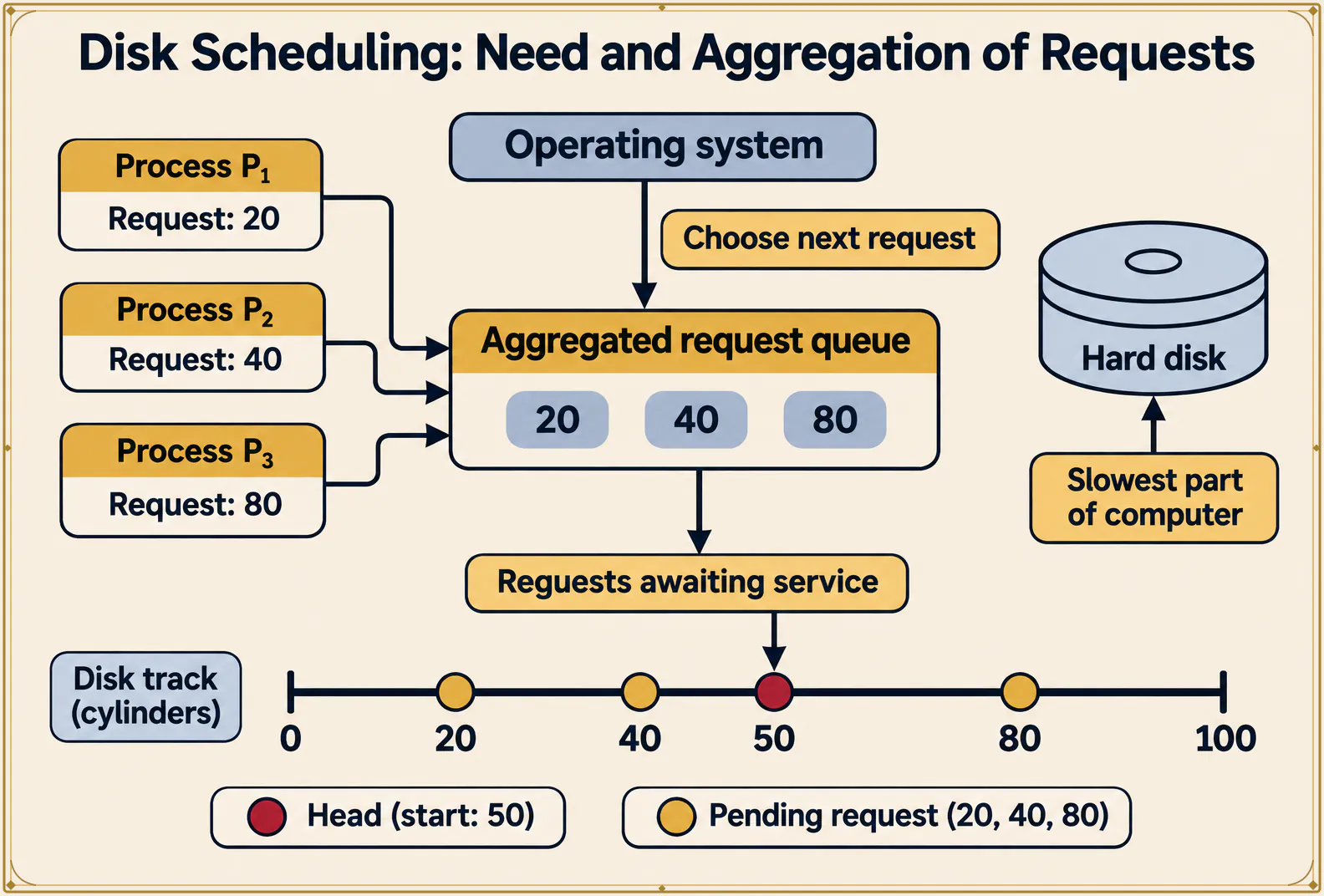
Disk scheduling is the decision of which pending disk request to serve next when a hard disk has a queue of waiting requests. It matters because the hard disk is the slowest part of the computer, so access to it must be made efficient.
Key concepts
- Disk scheduling: given a hard disk and a queue of requests waiting to be served, the problem/decision of which request should be served next. It determines the order in which pending disk access requests are handled.
- Aggregation: the combining of all pending requests from all processes into one set/queue, from which the next request is chosen.
- Hard disk as bottleneck: the hard disk is the slowest part of the computer, so disk access must be done efficiently.
- Request buildup: as a computer deals with multiple processes over a period of time, a list of requests to access the disk builds up.
- Core scheduling question: among all aggregated pending requests, which request is served next?
How it works
- File systems must be accessed in an efficient manner, especially because the hard disk is the slowest part of the computer.
- Every file is stored on the hard disk; since the hard disk is slow, disk access must be done efficiently.
- As a computer deals with multiple processes over a period of time, a list of requests to access the disk builds up.
- For efficiency, all requests from all processes are aggregated together.
- When multiple processes are blocked waiting to get service from the hard disk, all of their requests are kept in a queue.
- All these requests must be considered together, and the operating system must decide which one to process next. This combining of all pending requests into one set/queue is called aggregation.
- All requests are considered together and access is provided to all of them as one combined set of requests.
This does not mean all requests are physically served at the same instant; it means they are combined into a single scheduling queue/pool from which the next request is chosen.
Revision summary
- Disk scheduling answers exactly one question: which request is served next from the queue of pending requests.
- The hard disk is the slowest part of the computer — this is the reason efficient disk access matters.
- Requests accumulate because multiple processes run over a period of time.
- Aggregation = combining all pending requests from all processes into one queue/pool.
- Aggregation does not mean all requests are physically served at the same instant; the next request is chosen from the combined queue.
- Blocked processes waiting for disk service have their requests kept in the queue.
Previous-year exam insights
- Disk access time = seek time + rotational latency + transfer time;
average rotational latency = half of one full rotation = 60/(2×RPM) seconds.
Asked inGATE 2024GATE 2015GATE 2011 - Disk capacity = number of cylinders × number of surfaces (heads) × sectors per track × bytes per sector;
number of cylinders = capacity / (surfaces × sectors per track × bytes per sector).
Asked inGATE 2024GATE 2013 - For a file of N sectors read with one seek per sector, total time = N × (average seek + average rotational latency + transfer time per sector);
if sectors are contiguous, only one seek and one rotational latency are counted.
Asked inGATE 2024GATE 2015 - In SSTF, always serve the pending request with the minimum seek distance from the current head position; ties are broken by direction of head movement, and SSTF can cause starvation of far requests.
Asked inGATE 2020GATE 2015GATE 2014 - In SCAN (elevator) the head moves in one direction serving all requests in its path up to the end, then reverses; in C-SCAN it returns to the other end without servicing on the return, and in C-LOOK/LOOK it reverses at the last pending request rather than at the disk end.
Total head movement is the sum of absolute differences of consecutive serviced cylinders.
Asked inGATE 2016GATE 2015 - Disk addresses are of the form (cylinder/surface/sector) or (platter, cylinder, sector); a sector's linear position is computed as cylinder × (surfaces × sectors per track) + surface × sectors per track + sector, and the number of tracks crossed gives the seek distance.
Asked inGATE 2018GATE 2013