

UGC NET CS 2022Data Structures and Algorithms › Graph AlgorithmsVerified
UGC NET CS 2022 PYQ: Consider the following graph : For the graph; the following sequences of depth first search (DFS) are given…
Consider the following graph :
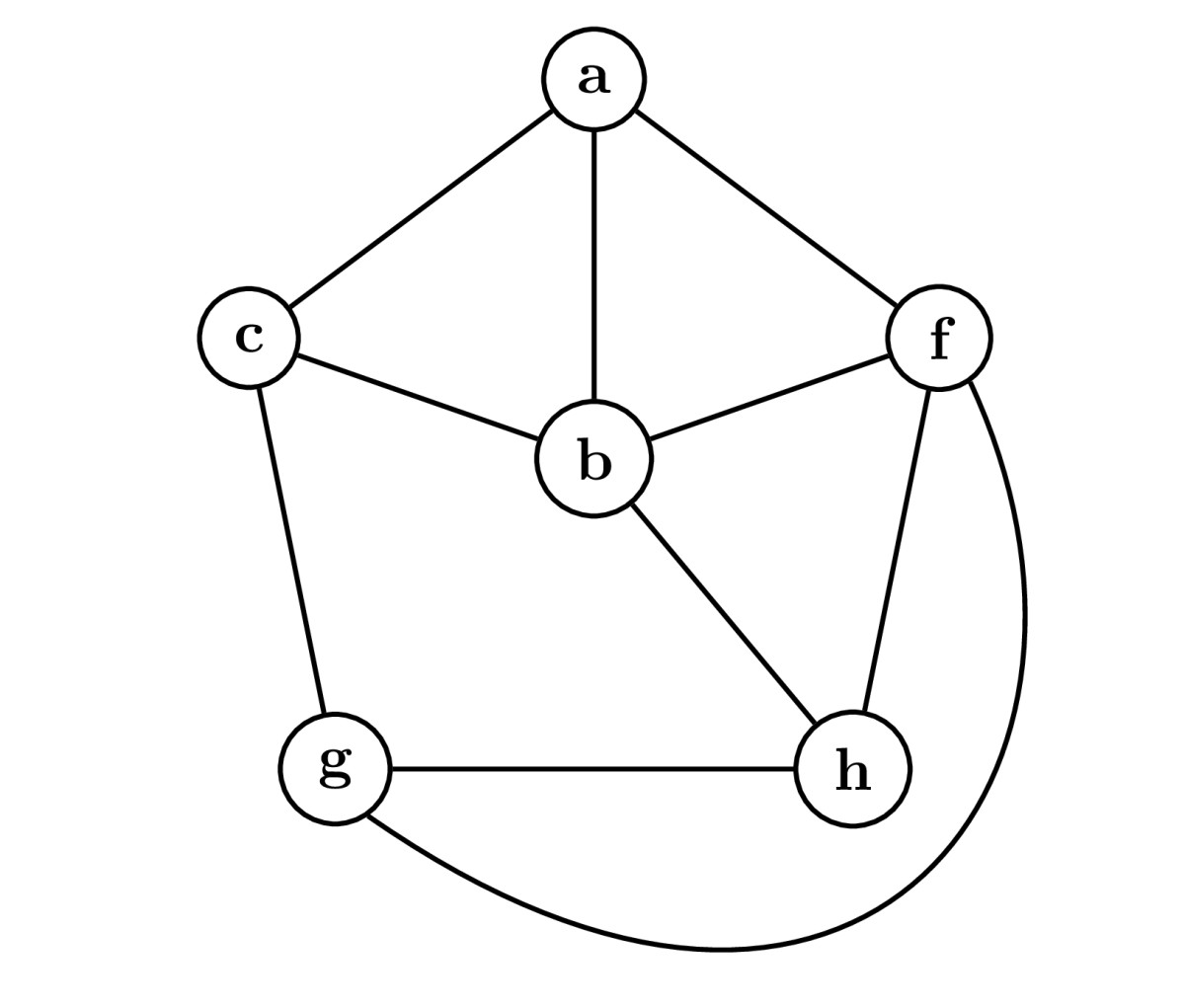
For the graph; the following sequences of depth first search (DFS) are given
- $\text{abcghf}$
- $\text{abfchg}$
- $\text{abfhgc}$
- $\text{afghbc}$
Which of the following is correct?
- A$(\text{I}), (\text{II})$ $\text{and}$ $(\text{IV})$ only
- B$(\text{I}), (\text{II}), (\text{III})$ $\text{and}$ $(\text{IV})$
- C$(\text{II})$, $(\mathrm{III})$ $\text{and}$ $(\mathrm{IV})$ only
- D$(\text{I}), (\text{III})$ $\text{and}$ $(\text{IV})$ onlyCorrect answer
Answer
(D) $(\text{I}), (\text{III})$ $\text{and}$ $(\text{IV})$ only
Approach
From the graph, adjacency is: a–{b,c,f}, b–{a,c,f,h}, c–{a,b,g}, f–{a,b,h,g}, g–{c,f,h}, h–{b,f,g}. A DFS sequence is valid iff each consecutive pair is an edge and it respects DFS order (each new vertex is a neighbor of the current one, backtracking allowed).
(I) a b c g h f: a–b, b–c, c–g, g–h, h–f — all are edges, valid.
(II) a b f c h g: after b→f, the next vertex c is NOT adjacent to f (f's neighbors are a,b,h,g), so invalid.
(III) a b f h g c: a–b, b–f, f–h, h–g, g–c — all edges, valid.
(IV) a f g h b c: a–f, f–g, g–h, h–b, b–c — all edges, valid.
Thus (I), (III), (IV) are correct DFS sequences, giving option D. (II) fails because f and c are non-adjacent.
Reviewed by UGC IQ Editorial Team.