
Computer Organisation and Architecture · ALU and Data Path
Adder Logic Unit Instead of Full ALU
Overview
The full ALU of a computer is replaced here by a simpler adder logic unit that performs only addition and a few logic operations.
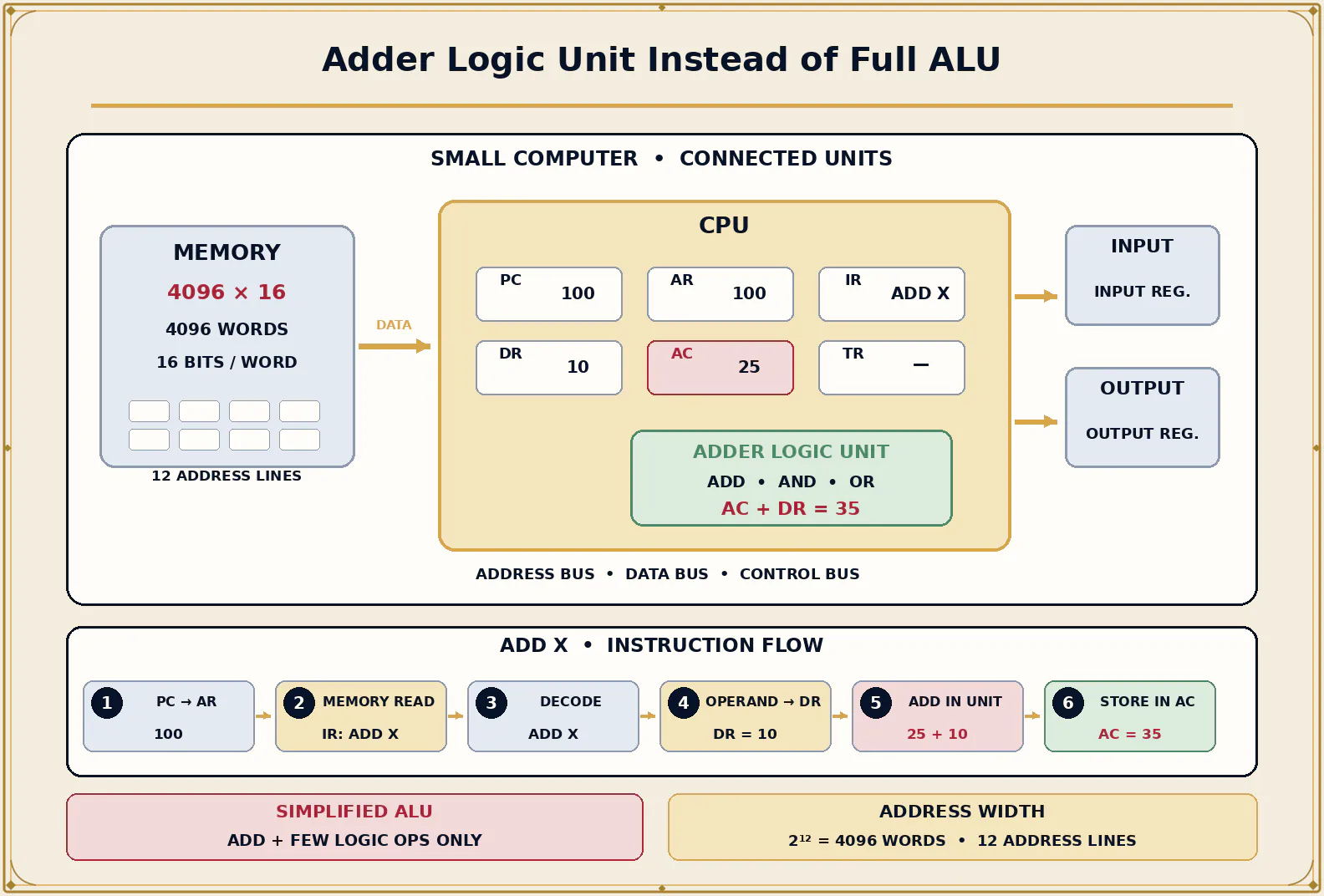
The machine is deliberately kept small so its internal working can be explained clearly, and it is built by connecting memory, registers, and the adder logic unit together.
Key concepts
- ALU (Arithmetic Logic Unit): the unit that normally performs all arithmetic operations (addition, subtraction, multiplication) and all logic operations (AND, OR, XOR, etc.).
- Adder Logic Unit (simplified ALU): a simpler unit that performs only addition and a few logic operations. It does not directly perform multiplication, subtraction, or exclusive OR.
- Reason for the simplification: to keep the machine as simple as possible so that the internal working of the computer can be explained and understood clearly.
A small computer is much easier to explain than a modern-day computer. - Machine composition: the complete computer is built by connecting together the memory, all the registers, and the adder logic unit.
- Memory size: 4096 × 16 — 4096 words, each word 16 bits.
- Registers: AR (Address Register), PC (Program Counter), DR (Data Register), AC (Accumulator), input register, instruction register, temporary register, and output register.
How it works
- Instead of a full-fledged ALU, use an adder logic unit supporting addition and a few logic operations only.
- Subtraction is still possible using the adder — it is implemented with the adder, e.g., via complement addition (standard two's-complement add).
- Multiplication and division are not built as single operations; they must be implemented by using the add operation many times (repeated addition).
- Having only an adder plus logic simplifies the circuit considerably.
- Build the complete computer by connecting the memory, all the registers, and the adder logic unit.
- After connecting these units, decide how to apply the timing signals and the control signals to perform the required manipulations.
Formulas
- — so the memory needs 12 address lines.
- — 4096 words, each word 16 bits.
Worked examples
Memory specification used in the design:
- Memory = 4096 × 16
- Number of words = 4096 = , so 12 address lines are needed.
- Word size = 16 bits, so each memory word holds 16 bits of data.
Comparison
| Feature | Full ALU | Adder Logic Unit (this design) |
|---|---|---|
| Addition | Yes | Yes |
| Subtraction | Yes (direct) | Yes, using the adder |
| Multiplication | Yes (direct) | No — done by repeated addition |
| Division | Yes (direct) | No — done by repeated addition |
| Exclusive OR / all logic ops | Yes | Only a few logic operations |
| Circuit complexity | Higher | Lower (simpler) |
| Purpose here | — | Simplicity for understanding the machine |
Revision summary
- The simplified ALU is called the adder logic unit: addition + a few logic operations only.
- Subtraction is achievable with the adder; multiplication and division require repeated addition.
- The machine is assembled from memory (4096 × 16), the eight registers (AR, PC, DR, AC, input register, instruction register, temporary register, output register), and the adder logic unit.
- Timing signals and control signals must be designed to drive these connected units.
- The simplification is deliberate: a small computer is easy to explain; a modern computer is not.
- 4096 words = , hence 12 address lines; each word is 16 bits.
Previous-year exam insights
- A half adder adds two input bits and produces a sum (XOR) and a carry (AND); a full adder adds three input bits (two operands plus carry-in) and produces sum and carry-out.
A full adder can be built from two half adders plus an OR gate.
Asked inUGC NET 2013 - A NOT gate (inverter) accepts one Boolean input and produces its complement; it is not an adder.
Asked inUGC NET 2013 - Subtraction A − B is performed as A + (two's complement of B) = A + B̄ + 1, i.e. complement the subtrahend and set the adder's carry-in to 1.
- Multiplication by repeated addition needs a counter and an accumulator: add the multiplicand to the accumulator as many times as the multiplier value, so time is proportional to the value of the multiplier (up to additions for an n-bit multiplier); shift-and-add reduces this to about n additions.
- Division by repeated subtraction: repeatedly subtract the divisor from the dividend (or partial remainder) and count the subtractions until the remainder is less than the divisor; the count is the quotient and the final remainder is the remainder.
- With a word-addressable memory of words, k address lines are required and the address register (AR) must be at least k bits wide; the data register (DR) and memory word width equal the word size.