
Computer Organisation and Architecture · ALU and Data Path
Arithmetic and Logic Unit (ALU)
Overview
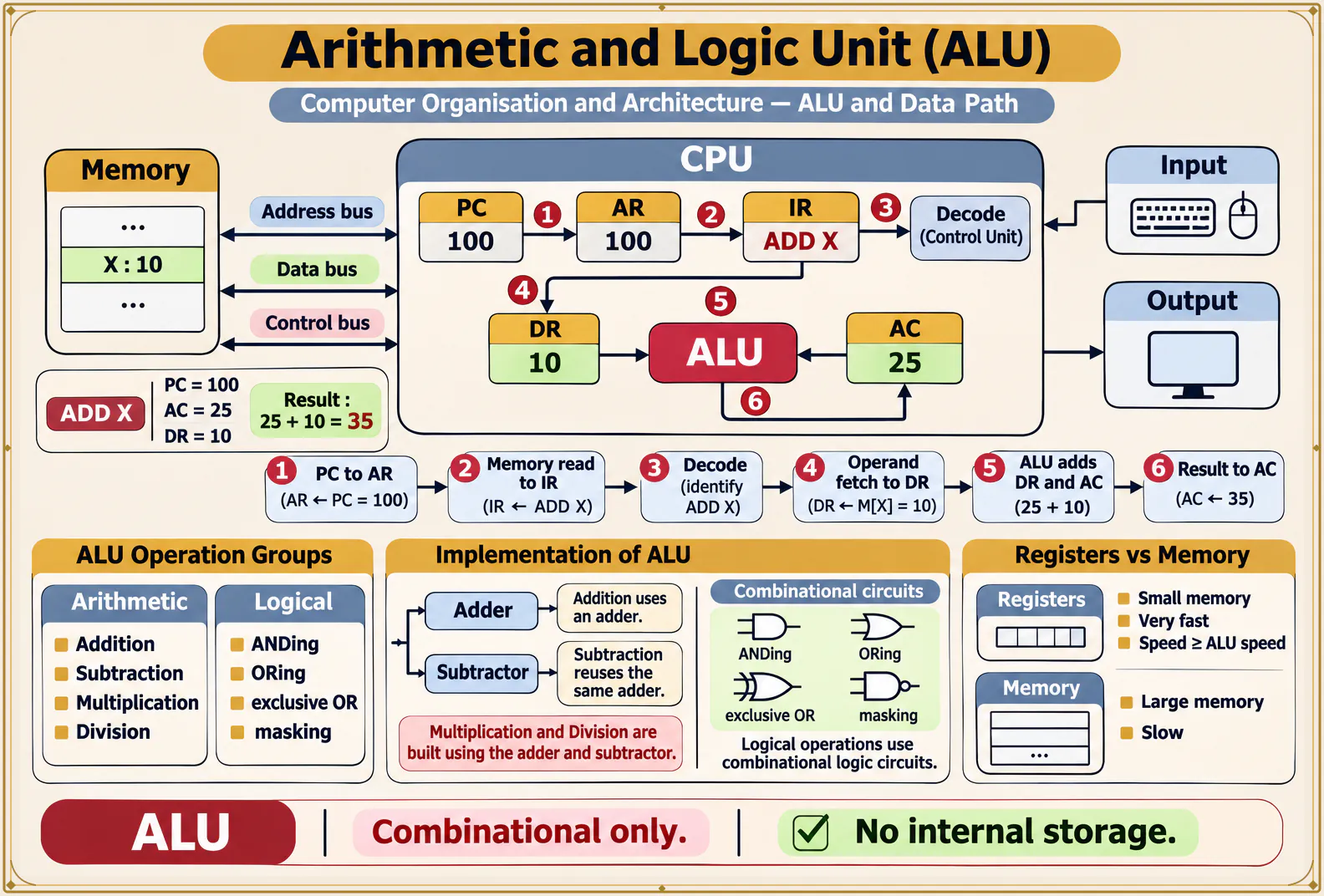
The ALU (Arithmetic and Logic Unit) is the hardware block inside a processor that carries out all arithmetic and logical operations.
Every processor instruction ultimately reduces to operations performed by the ALU, which is why its structure and speed set the pace for the rest of the data path.
Key concepts
- ALU (Arithmetic and Logic Unit): the circuit / hardware block that performs the arithmetic and logical operations of a processor.
- Arithmetic operations: addition, subtraction, multiplication, division.
- Logical operations: ANDing, ORing, exclusive OR, masking.
- Adder as the core building block: an adder performs addition, and the same adder is used to perform subtraction; from the adder and subtractor, multiplication and division are built.
- Logic circuits: the circuits for ANDing, ORing, exclusive OR, etc., are standard digital-electronics blocks.
- Combinational only: internally the ALU is organized from combinational circuits only.
- Registers (motivation): a small, fast memory whose speed at least matches the ALU's speed is needed; this need leads to small memory units called registers.
How it works
- The ALU receives operands and performs the required arithmetic operation (add, subtract, multiply, divide) or logical operation (AND, OR, XOR, masking).
- Addition uses an adder; subtraction reuses the same adder; multiplication and division are performed using the adder and subtractor.
- Logical operations use the corresponding combinational logic circuits.
- All internal operation is combinational — there is no internal storage in the ALU.
- An ALU plus a memory is not enough to execute instructions: the ALU hardware is faster, while memory is slow because it is very large, so getting into memory and fetching data takes time.
- A smaller, faster memory is therefore required whose speed at least matches the ALU's speed (it need not be faster than the ALU, but it must come up to the ALU's speed). This leads to the small memory units called registers.
Revision summary
- The ALU handles both arithmetic and logical operations — not just arithmetic.
- Subtraction is done with the adder; multiplication and division are built from the adder/subtractor.
- The ALU is purely combinational internally.
- ALU + memory alone cannot execute instructions.
- The ALU is fast; main memory is huge and slow.
- The required small memory need not be faster than the ALU — it must at least match the ALU's speed.
- Memory design (decoder, RAM matrix) belongs to digital electronics and is not part of this section.
Previous-year exam insights
- The ALU also produces status/condition flags (zero, sign, carry, overflow) that are stored in a status register and used by conditional branch instructions; the ALU itself stores nothing.
Asked inGATE 2025UGC NET 2017 - The ALU is part of the CPU's datapath and works together with registers and the control unit; the control unit generates the select signals that tell the ALU which operation to perform.
Asked inUGC NET 2017UGC NET 2012 - The ALU word size (number of bits it processes at once) equals the processor's word length; an n-bit ALU operates on n-bit operands and produces an n-bit result plus flags.
Asked inUGC NET 2016 - Addition and subtraction of n-bit numbers are performed by a single n-bit parallel adder (ripple-carry or carry-look-ahead); subtraction uses two's complement (A + B' + 1) with the same adder, so no separate subtractor hardware is needed.
Asked inGATE 2025 - A datapath built from registers, an ALU and buses can perform register-to-register operations; immediate operands require a path that feeds the constant into the ALU input, and memory operands require a load/store path.
Asked inGATE 2025 - Data is added and compared in the CPU (in the ALU), not in memory or secondary storage; memory only holds data and instructions.
Asked inUGC NET 2012